

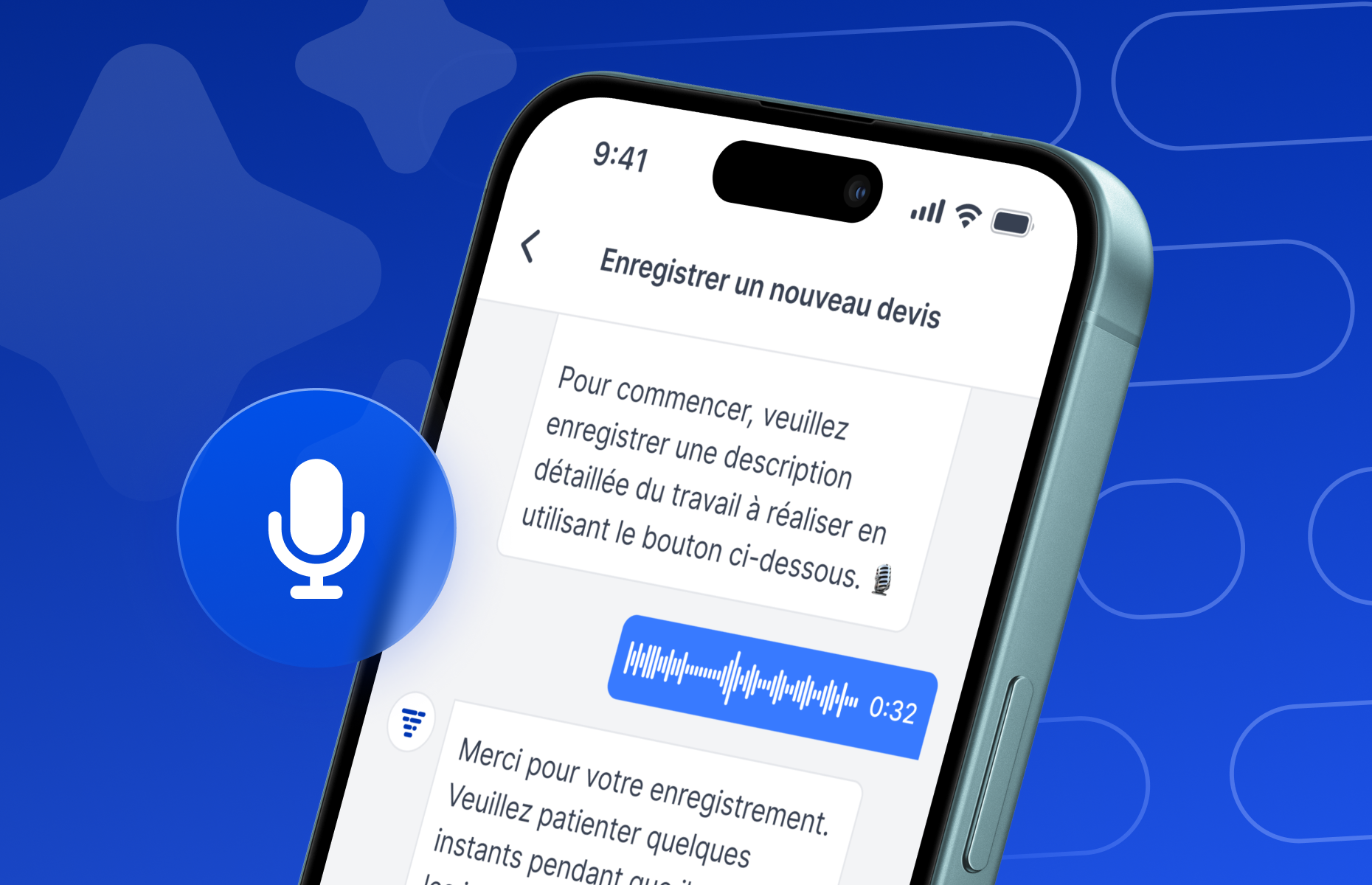
A construction contractor receives a call while he's on site. A potential client wants a quote to renovate their kitchen. The contractor quickly jots down the information on a crumpled piece of paper, hands covered in plaster. He promises to send the quote "as soon as possible."
Back at the office at the end of the day, exhausted, he opens Excel. He searches for his prices across several files. He calculates the surface areas. He adds things up. He applies VAT. He makes a mistake in a formula. Two hours later, he finally sends his quote. But in the meantime, a more reactive competitor has already sent theirs from their smartphone, directly from the client's home.
The contractor loses the contract.
The problem Vertuoza wanted to solve
Vertuoza had already digitized construction site management for thousands of tradespeople. But their users constantly raised the same frustration: creating quotes was still a manual nightmare.
The numbers were clear. An average construction quote required 2 to 3 hours of work: searching for prices, multiple calculations, VAT verification, professional formatting. Calculation errors cost an average of 5 to 15% in margin on underestimated projects. And above all, the inability to create a professional quote directly on site meant losing contracts to more reactive competitors.
Vertuoza came to us with a vision: "What if a tradesperson could simply describe their project out loud, and instantly receive a professional quote?"
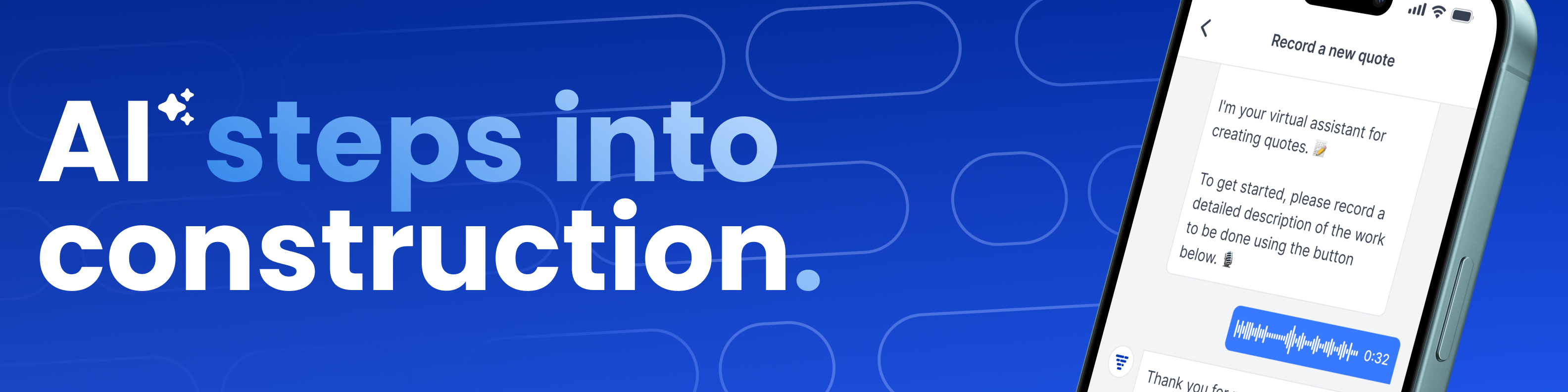
Our approach: voice-first, not voice-only
Understanding on-site constraints
The central challenge was designing for tradespeople in real on-site situations. A tradesperson often has dirty or occupied hands. Voice then becomes their only available means of interaction. But creating a quote is not a linear process. It's iterative. The tradesperson starts with the broad strokes, then remembers a detail, adds a forgotten line item.
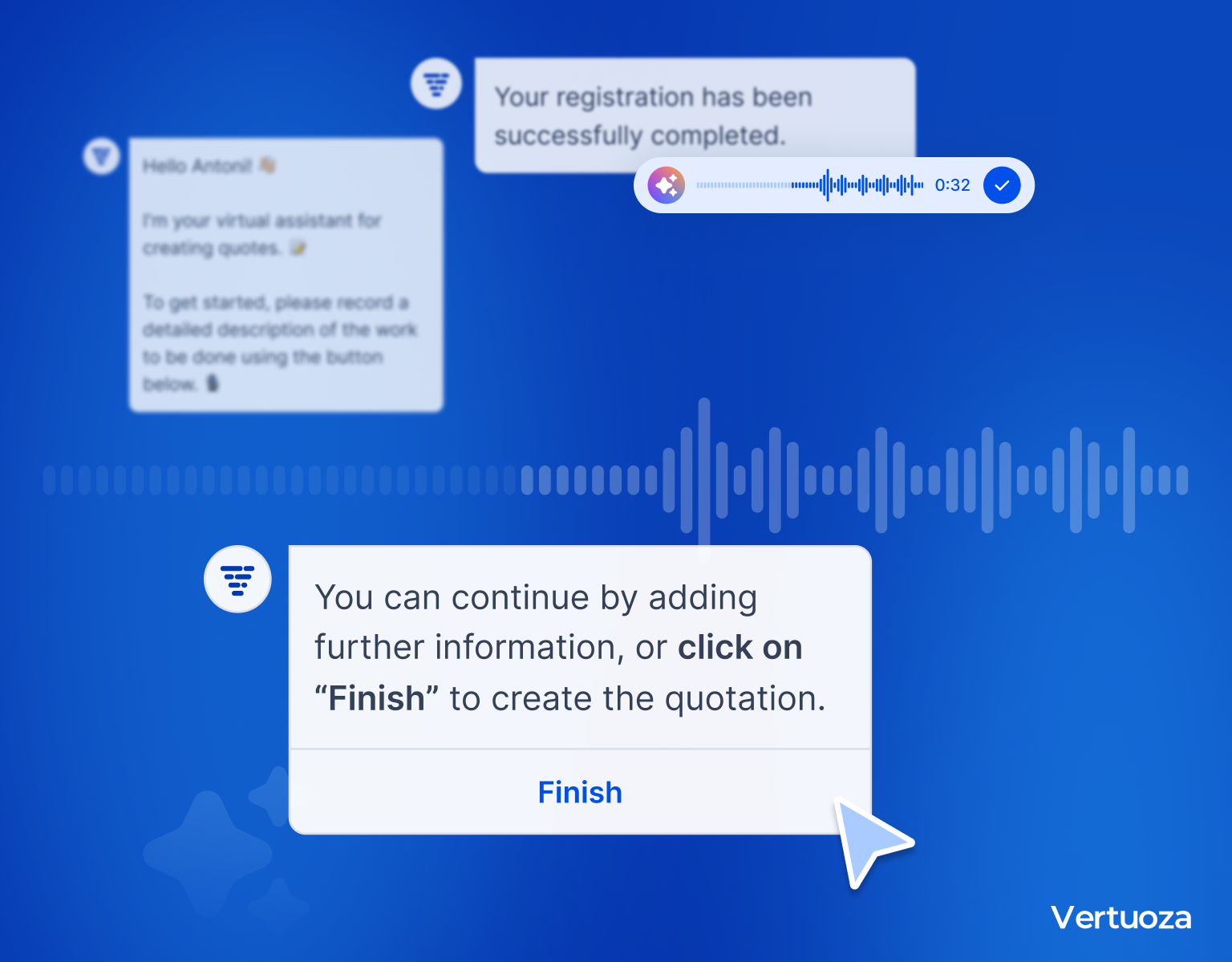
Our architectural decision: allow the tradesperson to record multiple successive voice messages before generating their quote. They record a first description of their project. They can then add a second recording to fill in forgotten details. Once all voice recordings are done, they generate the final quote based on all of this information. If they want to modify after generation, they must add a new voice recording and regenerate, or manually edit within the interface.
The challenge of specialized vocabulary
Construction vocabulary is riddled with technical terms, abbreviations, and trade jargon that standard voice recognition systems don't naturally understand. "BA13" (plasterboard), "screed," "IPN" (steel beam), "OSB" are everyday terms for a tradesperson but completely opaque to a general-purpose AI.
We had to build a specialized adaptation layer on top of voice recognition. A system capable of understanding context: when the tradesperson says "fifteen square," they mean fifteen square metres. When they say "one ten per square," they mean 110 euros per square metre.
This industry specialization is what transforms an impressive demo into a professional tool that's genuinely usable in the field.

The technical challenges we solved
Cascading automatic calculations
A construction quote is not a simple price list. It's a hierarchy of nested calculations. Take a concrete example:
The tradesperson describes verbally: "Kitchen tiling, twelve square metres, tiles sixty euros per square metre, installation forty euros per square metre, plus skirting boards four linear metres at fifteen euros per metre."
The system must instantly calculate:
- Tile materials: 12 m² × €60/m² = €720
- Tile installation: 12 m² × €40/m² = €480
- Skirting boards: 4 m × €15/m = €60
- Subtotal: €1,260
- VAT 21%: €264.60
- Total incl. VAT: €1,524.60
If the tradesperson wants to add an element such as "Add floor preparation, one hundred and fifty euros," they record an additional voice message before generating the final quote. When generating, all calculations cascade automatically. This complete automation eliminates the manual calculation errors that were costing tradespeople up to 15% in margin on certain projects.
Integration with the existing ecosystem
Vertuoza already had a database of standard construction prices in their system. Our challenge was to allow the voice assistant to access it naturally.
When the tradesperson says "Standard plasterboard installation," the system automatically searches the Vertuoza library, identifies the corresponding unit price, and proposes it to the tradesperson for confirmation. This integration dramatically speeds up creation by avoiding the need to manually search for each price.
The application also integrates with the rest of the ecosystem: professional PDF export, formatted email sending, CRM synchronization for sales follow-up, and multi-device cloud access.
The result: 160 seconds for a complete quote
The metric that changes everything
Before: 2 to 3 hours to create a complete construction quote with price research, calculations, and formatting.
After: 160 seconds to generate a complete professional quote via voice assistant.
This 90% reduction in time radically transforms the daily routine of Vertuoza's tradespeople. What used to take an entire evening after a day on site now takes less than three minutes, often directly at the client's construction site.
Business impact beyond time
Zero calculation errors. Complete automation of calculations eliminates human errors in Excel formulas. No more underestimated quotes eroding margins. No more dissatisfied clients due to VAT mistakes.
On-site quoting. The ability to generate a professional quote directly during the site visit transforms the client's perception. The tradesperson comes across as reactive and professional. The client receives their quote immediately instead of waiting two days. This responsiveness significantly improves the conversion rate.
Price standardization. For companies with multiple tradespeople, integration of the price library ensures everyone uses the same rates. No more inconsistencies where two tradespeople from the same company give different prices for identical work.
What this project reveals about the Nightborn approach
AI in service of the trade
We didn't build "a generic voice assistant" that we superficially adapted for construction. We built a solution specifically designed for construction tradespeople: their vocabulary, their workflows, their on-site constraints, their need for financial precision.
This deep industry specialization is what differentiates a tool usable on a daily basis from an impressive but production-unusable tech demo.
Transparency and user control
Voice AI makes mistakes. Our approach doesn't try to hide them. On the contrary, we display the transcription immediately. The tradesperson sees what the AI understood. They can correct before generating the final quote.
This transparency builds trust. The tradesperson isn't afraid that the AI will generate a completely wrong quote without them noticing. They maintain control while benefiting from the automation.
Architecture designed for evolution
The system is not static. It learns continuously. Every new technical term detected enriches the vocabulary. Every interaction improves contextual understanding. In six months, the accuracy will be better than today.

Lessons for any company wanting to integrate voice AI
General-purpose AI is not enough
Standard voice recognition models are impressive. But they don't understand the specialized jargon of your industry. You need to build an industry adaptation layer on top. That layer is what transforms generic technology into a specialized professional tool.
Voice-first doesn't mean voice-only
Voice is powerful when your hands are occupied. But it must be complemented by visual feedback and the ability to quickly make corrections. Purely voice-driven interfaces become frustrating the moment you want to correct or refine something.
Transparency creates trust
Don't hide what the AI understands. Show the transcription. Allow corrections. Give the user final control. Trust comes from transparency, not from opaque "magic."
Measure business impact, not technical performance
Voice recognition accuracy matters technically. But what matters for the business: time saved, errors eliminated, contracts won. Focus on the metrics that directly impact the bottom line.
Conclusion: when AI solves real problems
The Vertuoza project demonstrates that voice AI is not a futuristic gadget but a concrete business transformation tool when correctly implemented for a specific trade.
The 160 seconds of quote generation is not just a number. It's the difference between a tradesperson who comes home exhausted to spend two hours on Excel, and a tradesperson who sends their professional quote from their smartphone while leaving the client's site.
A solution designed for the trade. A 90% reduction in time. A tool that transforms the daily lives of thousands of tradespeople.
Is your team losing time on repetitive manual tasks that voice AI could automate?
Vertuoza proves that with a deep understanding of the trade and an adapted technical approach, voice AI can transform critical workflows.
📧 hello@nightborn.com | 🌍 Brussels, Belgium | 🔗 nightborn.be
Let's discuss how we could design a voice AI automation solution adapted to the specific constraints of your industry.
.webp)
