

There is a paradox settling quietly into product teams in 2026: they have never delivered more, and yet the metrics that matter are not moving. Dashboards are active, sprints close on time, demos impress. And adoption stagnates. This is not a prioritisation problem in the classical sense. It is a diagnostic problem: the bottleneck has moved, and most organisations have not noticed yet.
When execution becomes cheap
For years, the primary constraint of a product team was build time. Deciding what to build was hard, but building it was harder. That high execution cost functioned as a natural filter: you did not start a sprint on an unvalidated idea because the price of being wrong was too high.
AI removed that filter. The Product Journey documents the clearest market signal of this shift: product manager hiring is up 75% year-over-year, according to data from Lenny Rachitsky, while designer hiring has remained nearly flat. Teams are no longer looking for additional execution capacity. They are looking for decision-making capacity.
The logic had seemed straightforward: faster prototyping would mean better decisions, more experiments would produce clearer insights. The reality is different. When coding three onboarding variants takes an afternoon, the real cost does not disappear. It shifts. It becomes the cost of choosing which one to ship, aligning the team on that choice, and accepting that the other two variants will not be built.
Decision debt, the invisible cost of perpetual motion
How do you know whether your team is suffering from an excess of execution rather than a lack of it? The symptoms are specific. Decisions are not made: they are deferred. Build a few versions and A/B test. See what users think of all three. Decide once we have more data. Testing becomes permanent. Learning loops break. Experiments stop generating conviction and start generating ambiguity.
This is what the source article calls decision debt, in direct analogy with technical debt. Like technical debt, it accumulates silently, slows everyone down without anyone being able to identify a precise cause, and becomes exponentially more costly as it grows. A team that never commits to a direction does not learn. It produces data without drawing conviction from it.
The State of Product Management 2025 survey by Product School found that 61% of heads of product in Europe cite internal alignment as their primary obstacle, ahead of technical resources. That figure would not have carried the same weight five years ago. It measures precisely the shift described here: the problem is no longer building, it is deciding together what to build.
When anyone can build, who decides?
There is a third effect that the source article calls the too-many-cooks problem. When execution becomes accessible to everyone, everyone becomes a product manager. Engineers run their own experiments. Designers ship their own variants. PMs spin up competing versions. Output explodes. Ownership evaporates. Nobody is the natural DRI at the precise moment when accountability is the scarcest resource.
IBM made this explicit at its Think 2026 conference by centring its programme on orchestrating and governing the agentic enterprise. Not because agents are new, but because coordinating autonomous systems requires architecture, not just tooling. The same logic applies to a product team in 2026: what is missing is not the capacity to build. It is the architecture that determines who decides, when, and on what basis.
Product prioritisation in this context is no longer a backlog management exercise. It is an organisational architecture question: who has the mandate to say no to a feature that has been built but not shipped? What criteria transform a prototype into a decision? When does an experiment generate enough conviction to stop testing?
What this means for a Head of Product
The Head of Product at Series A who recognises this pattern faces a real constraint: he is himself caught in the decision inflation. The more features that become possible, the more he arbitrates, and the less bandwidth he has for the decisions that actually orient the product. The bottleneck has moved toward him.
The answer is not to have fewer options. It is to reduce the surface over which those options operate. Teams that break this pattern do not build less: they build with more conviction across fewer simultaneous fronts. Two prototypes maximum before forcing a choice. Escalation paths defined before disagreement arrives. Decision thresholds set in advance rather than negotiated case by case.
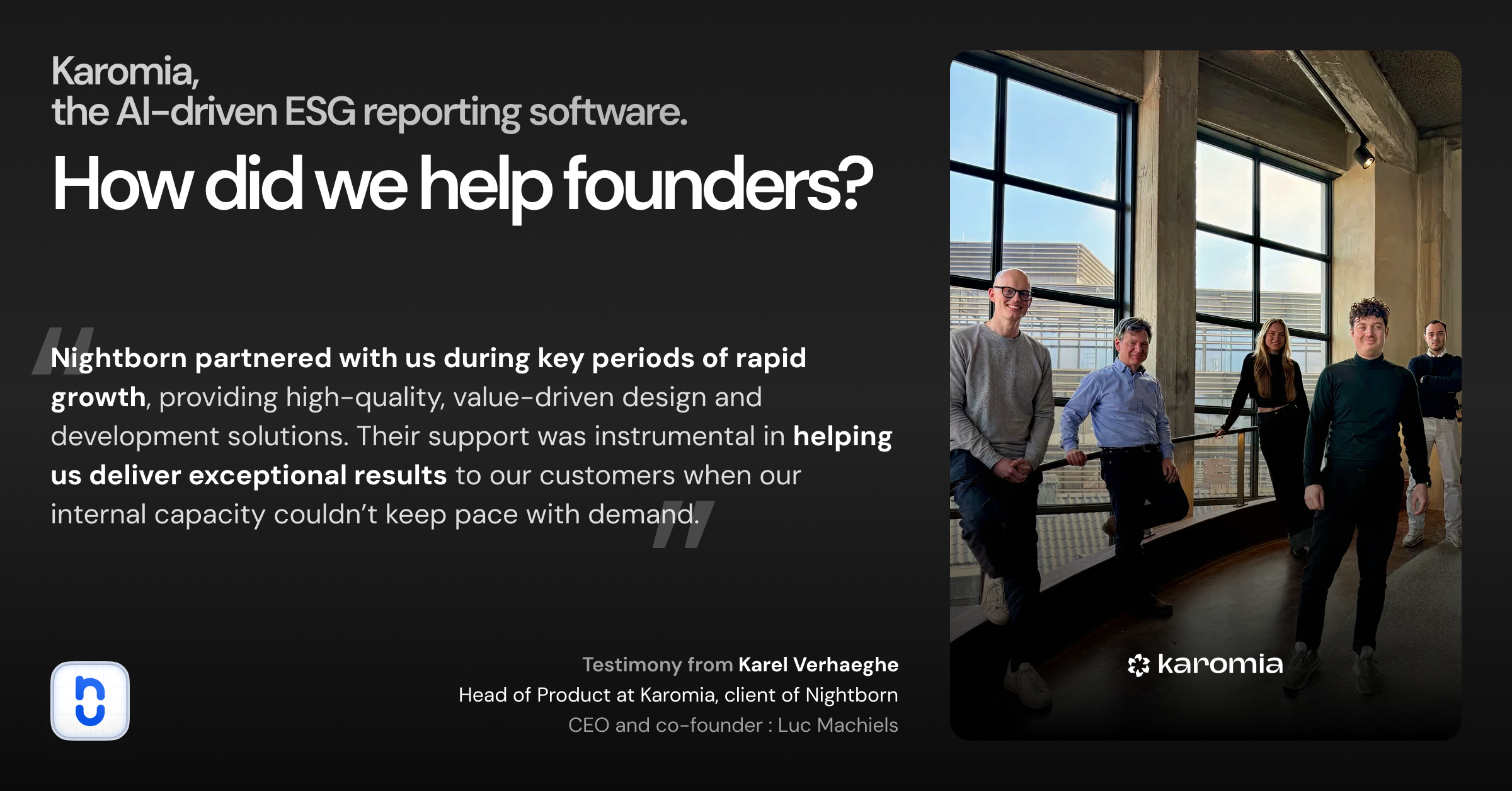
At Nightborn, the first question we ask is not what are we building. It is what needs to change in your users' behaviour. That question puts the decision before the execution, and mechanically reduces the number of features worth building. Taking on the execution of high-risk technical projects frees the Head of Product's bandwidth for what cannot be delegated: deciding what is worth building, and holding that line.
If your team ships regularly and your adoption metrics are not following, the problem is probably not execution. Let's talk about the decision architecture behind your roadmap.
.webp)